.png?width=20&height=20&name=Icon%20(Stroke).png)

.png?width=20&height=20&name=Type=Outline%20(3).png)
.png?width=20&height=20&name=Type=Outline%20(2).png)

The benefits of using manipulatives in math go well beyond making learning more engaging. Hands-on materials give students the opportunities to explore mathematical concepts, develop problem-solving skills, and build a deeper understanding of how math works.
In grades 6-12, mathematics is more than memorizing formulas or following an order of operations. Students develop stronger mathematical reasoning when they have opportunities to investigate ideas, test solutions, and make connections through hands-on experiences.
For more than 60 years, Lab-Aids has supported educators in grades 6-12 with hands-on learning materials designed to encourage exploration and discovery. Now, that same commitment to active learning extends to mathematics through classroom materials that help students engage with concepts in meaningful ways.
What Are Math Manipulatives?
Math manipulatives are hands-on tools that help students visualize and explore mathematical concepts through physical interaction. Rather than learning only through written problems or abstract symbols, students can use materials to represent ideas, test strategies, and develop a stronger understanding of mathematical relationships.
Math manipulatives can be used to support a wide variety of topics, including:
- Number sense and operations
- Fractions and decimals
- Ratios and proportional reasoning
- Geometry and measurement
- Algebraic thinking
- Data analysis and probability
By allowing students to interact with mathematical ideas, manipulatives create a bridge between concrete experiences and abstract thinking. Students can move from physically exploring a concept to applying that knowledge through equations, graphs, and problem solving.
Benefits of Using Manipulatives in Secondary Math Education
Many mathematical concepts can feel challenging because students are asked to understand ideas they cannot always see. Hands-on learning helps make these concepts more accessible by giving students opportunities to visualize relationships, explore solutions, and understand how mathematical ideas work.
In secondary math classrooms, manipulatives help students move beyond memorizing formulas and procedures. Instead, students can investigate concepts, test solutions, and develop the reasoning skills needed to apply their knowledge. These hands-on experiences encourage deeper learning by helping students understand both the process and purpose behind mathematical concepts.
Using manipulatives in secondary math helps students:
- Make connections between concepts
- Explain their mathematical thinking
- Collaborate with classmates
- Develop critical-thinking skills
- Build confidence when solving problems
Build Deeper Conceptual Understanding
One of the biggest advantages of manipulatives is that they help students understand why mathematical concepts work, not just how to complete a problem.
Before moving to formulas, equations, or abstract representations, students can use physical materials to explore mathematical relationships. This foundation helps students develop stronger understanding and apply their knowledge to more complex problems.
Increase Student Engagement
Hands-on materials create opportunities for students to actively participate in learning. When students can explore concepts, test ideas, and discover solutions, mathematics becomes more interactive and meaningful.
Manipulatives encourage curiosity and help create a classroom environment where students feel comfortable asking questions, sharing ideas, and working through challenges.
Encourage Problem Solving and Collaboration
Math manipulatives provide students with opportunities to approach problems from different perspectives.
As students work together, they can compare strategies, explain their reasoning, and learn from one another. These conversations strengthen mathematical communication skills while helping students recognize that there can be multiple approaches to solving a problem.
Support Different Learning Needs
Every student learns differently. Some students benefit from visual representations, while others learn best through hands-on experiences.
Manipulatives provide another way for students to access challenging concepts and support different learning needs in the classroom. They allow educators to introduce concepts in ways that are engaging and accessible for more learners, including multilingual learners and students with diverse learning needs.
Connect Concrete Learning to Abstract Thinking
A major benefit of manipulatives is their ability to help students transition from physical exploration to abstract problem solving.
Students can first build understanding through hands-on activities before applying concepts using numbers, symbols, equations, and written explanations. This progression helps students develop skills they can use throughout their mathematical journey.
How Lab-Aids Supports Hands-On Math Learning
For decades, Lab-Aids has helped educators bring hands-on learning into classrooms through high-quality instructional materials. With a foundation built in science education, Lab-Aids understands the value of giving students opportunities to investigate, explore, and learn by doing.
That same philosophy now extends to mathematics.
Lab-Aids math materials are designed to help educators:
Bring abstract concepts to life
Students can use hands-on materials to visualize mathematical ideas and build understanding through exploration.
Support meaningful instruction
Classroom-ready materials provide educators with the resources they need to create engaging learning experiences.
Encourage inquiry-based learning
Students can investigate problems, develop solutions, and strengthen their mathematical reasoning.
Save valuable preparation time
Organized materials help educators spend less time gathering supplies and more time focusing on instruction.
By supporting hands-on learning, Lab-Aids helps educators create mathematics classrooms where students are actively engaged in discovery.
Connected Mathematics® 4: Supporting Hands-On Math Instruction
Lab-Aids’ commitment to hands-on learning extends to Connected Mathematics® 4 (CMP4), a research-based mathematics curriculum developed by a Michigan State University team, the Connected Mathematics Project, with more than 30 years of experience designing, testing, and refining the program.
CMP4 encourages students to investigate mathematical ideas, solve problems, and develop reasoning skills through meaningful exploration.
To support CMP4 instruction, Lab-Aids provides classroom material kits designed specifically for the program. These kits include the materials educators need to implement hands-on math investigations and give students opportunities to learn through discovery.
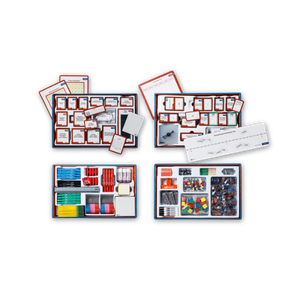
CMP4 supports Grades 6 through 8 and Algebra with topics including:
- Algebraic reasoning
- Fractions and rational numbers
- Ratios and proportional reasoning
- Geometry and measurement
- Statistics and probability
- Linear relationships and functions
- Mathematical modeling
By combining research-based curriculum with classroom-ready materials, Lab-Aids helps educators create engaging math experiences that encourage students to think critically and build confidence.
Empowering Educators with Hands-On Math Solutions
The benefits of using manipulatives in math go beyond engagement. These hands-on tools help students develop deeper understanding, strengthen problem-solving skills, and build confidence in their ability to approach mathematical challenges.
With more than 60 years of experience supporting hands-on STEM education, Lab-Aids provides educators with the resources needed to create meaningful learning experiences. Through programs like Connected Mathematics® 4 and classroom-ready math materials, Lab-Aids helps schools bring active, inquiry-based learning into mathematics classrooms.
Ready to bring hands-on math learning into your classroom? Explore Lab-Aids math materials and discover resources designed to support student success.

Frequently Asked Questions
What are the benefits of using manipulatives in secondary math?
The benefits of using manipulatives in secondary math include helping students better understand abstract concepts, develop problem-solving skills, and make connections between physical models and mathematical reasoning. Hands-on materials encourage exploration, collaboration, and deeper learning while also supporting multilingual learners and students with diverse learning needs by providing visual and tactile ways to engage with mathematical concepts.
What are examples of math manipulatives?
Examples of math manipulatives include hands-on tools that help students explore mathematical concepts through active learning. Common examples include shape sets, angle rulers and protractors, number cubes, spinners, polystrips, snap cubes, and relational solids, each designed to support different areas of mathematics. These tools allow students to model problems, test solutions, and develop a deeper understanding of mathematical concepts.
How does Lab-Aids support hands-on math instruction?
Lab-Aids supports hands-on math instruction through classroom materials designed to complement programs like Connected Mathematics® 4 (CMP4). By combining research-based curriculum with classroom-ready kits, Lab-Aids helps educators create engaging learning experiences where students can investigate, reason, and problem solve.
You Might Also Like…